
I flew to Guatemala to hike as many spectacular volcanoes as possible  I started with hiking Tajumulco – the highest peak in Central America, but I could not wait to witness Fuego Volcano eruptions (one of the most active craters in the world), which can be seen while obtaining the Volcan Acatenango hike.
Hiking Acatenango offers the closest and most dramatic views of Fuego lava explosions. Here is all you need to know about the magical Acatenango overnight hike in Guatemala.
Volcan Acatenango Hike.
Hiking Acatenango to watch Fuego erupt is, without exaggeration, one of the greatest adventures in the Americas.
I went with this tour and they absolutely the top choice: 2-day Volcan Acatenango Hike.
Do the overnight hike. The day hike gets you to the summit and back, but you miss the whole point: Fuego erupting in the dark. Eruptions happen every few minutes when Fuego is active, and they are ten times more dramatic at night.
The Acatenango hike is challenging, but trust me it’s worth every effort! In my opinion, the best option is booking a 2-day Acatenango Volcano hike – after reaching the Base Camp you will take an extra 4 hour hike (both ways) toward Fuego Volcano. This hike offers the closest and most dramatic views of Fuego lava explosions, and it’s an ideal spot to witness eruptions during nighttime. Fuego erupts every 15 minutes so most likely, you’ll be able to witness a lava explosion several times!
The Acatenango base camp.
Hundreds of people are approaching the tough Volcan Acatenango hike to see the most active Volcano in Central America!
The trail takes about 6 hours to the base camp, located at an altitude of 3700m above sea level, and an extra 2 hours to the Acatenango summit.
The Acatenango base camp is an ideal spot to witness eruptions during the night. Fuego erupts every 15 minutes, so most likely you’ll be able to witness a lava explosion several times!

Acatenango is the highlight of all the volcano hikes in Guatemala. The elevation of 3,976 meters might also cause high-altitude sickness, which can include headaches, nausea, and breathlessness.
The hike doesn’t require advanced technical skills, but it does demand good stamina and some experience with hiking in mountainous terrain.
With good preparation and knowing what to expect from the Acatenango Volcano hike in Guatemala, it’s doable for everyone with a decent fitness level. Here is a description of all the stages of the trail, along with useful tips for hiking Acatenango Volcano safely and successfully.
Acatenango overnight hike - SUMMARY.
Summit height | 3,976 m (13,045 ft) |
Base camp | about 3,400–3,600 m, depending on the operator |
Trailhead | La Soledad, about 1 hour by shuttle from Antigua |
Elevation gain | about 1,500 m to the summit |
Distance | about 13 km round trip |
Time to base camp | 4–6 hours |
Summit from camp | 1–2 hours, at sunrise |
Entrance fee (foreigners) | Q100 (about US$13), cash at the trailhead |
Overnight tour | about US$85–250 per person (*I would not go for the cheapest one but top-rated – safety is key on this mountain – I saw people with very bad high altitude sickness in Acatenango Base Camp). |
Fuego ridge add-on | about Q200–250 (US$25–35), where allowed |
Porter | about Q150–200 (US$20–25) each way |
Best months | November to April (dry season) |
Night temperature | around 0–5°C at camp; below freezing on the summit |
Guide | Required by Guatemalan authorities |
Useful tips for Acatenango Hike.
- Bring hiking poles – they are very beneficial for stability on loose terrain.
- Acclimatize ahead of the hike! If you don’t have much experience with heights, to increase your chances of summiting try to acclimatize in the region for a day or two before the hike.
- Carry at least 4.5 liters of water/isotonic.
- Bring Magnesium tablets – Magnesium is a mineral that is essential for healthy muscles.
- Bring some painkillers for headaches/just to be on the safe side.
- Go slow – this will reduce the chances of fatigue, so take regular breaks.
- Wear good hiking shoes! Trainers will make this hike a nightmare.
- You can hire PORTERS (some people do this if they want to hike Fuego at the same day). I carried my backpack myslef along the whole way and it is doable.

Acatenango Volcano high-altitude sickness.
Let me say few words about high-altitude sickness during the volcano Acatenango hike. It is unlikely you will experience severe symptoms of altitude, however, this happens. It depends on a variety of things but it is always good to have some medication in case it happens. Why do I say this?
I’ve seen people suffering from altitude sickness and you need to realize that there is LIMITED HELP on heights. There is no helicopter to take you down. No car or vehicle will be able to bring you down. Only people can help carry you down, which is very difficult on volcanic terrain and takes time.
There was one French lady at the Acatenango base camp who experienced serious altitude sickness symptoms. Few guides and porters had to carry her down so she could walk the rest of the trail herself. So this is not only you, but it will require engaging other people who will have to make a lot of effort to carry you down.
Acatenango Volcano hike summary.
It is always good to know what you are assigning to ALSO – there are plenty of stands on the way up, where you can buy drinks, snacks and fruits. Just in case you’re lucking of food, it is accessible along the trail.
STARTING POINT: 2.800 meters.
ALTITUDE: Acatenango stands at approximately 3,976 meters (13,044 feet).
WEATHER: The weather can be unpredictable, with cooler temperatures at higher altitudes (it gets really COLD!) and potential rain, particularly during the wet season from May to October.
DIFFICULTY: Most sources classify the hike as moderate to difficult, depending on your fitness level and hiking experience.
DURATION: There are two options: Acatenango day trip (an overnight trek) includes hiking to the Acatenango summit for sunrise (6-8 hours from the starting point); or a 2-day hike, with optional hiking to Volcan Fuego and a morning hike to Acatenango summit.
LENGTH: Approx. 18 kilometers in total.

How hard is hiking Acatenango Volcano?
Acatenango hike is hard. It isn’t technical, but it is relentless. Almost all of the 1,500 metres of climbing happens in a few hours, with very little flat ground to recover on.
Three things make it tougher than the numbers suggest:
- The gradient. The trail goes straight up for most of the day. There are no gentle switchbacks to ease you in.
- The altitude. Antigua sits at about 1,500 m, so you arrive at camp more than 2,000 m higher than where you slept. Shortness of breath and headaches are common above 3,000 m.
- The volcanic sand. Near the top, every step slides half a step back. The final summit push on loose scree is the hardest part of the whole trip.
Here’s the good news. You don’t need to be an athlete. If you can walk uphill for an hour without stopping and you’ve done a few longer hikes, you can do this. Hikers of all ages make it to camp. Pacing matters more than fitness: the people who struggle most are often fit ones who start too fast.
Acatenango Volcano 2-day tour.
Choosing the right tour company for the Volcan Acatenango hike is crucial! Some tour operators are rated very low and trust me, you don’t want to end up with one of them and spoil this fabulous adventure.
Our guides were amazing in every aspect: they were open-minded, supportive, honest and caring. I booked this hike on my own and was finally linked to a Mexican group of 8 women – who along with the guides and their porters, made my trip unforgettable and one of the most stellar expeditions ever! We laughed and danced, and the atmosphere was just amazing!
How to choose a tour operator for hiking Acatenango in Guatemala?
I booked a tour with Adrenaline Tours, which charged me $90 for the hike (only because I booked other expeditions with them)! Eventually, the agency that led the expedition was called Brothers Expeditions, they have great reviews online and honestly, they were one of the best guides I have ever had for my adventures.
The Adrenaline Tours forgot to inform BE I’m a vegetarian..! which is a quite important aspect for a 2-day extreme hike!! The Brothers Expeditions said they never got any information about my vegetarian requirements but they managed to organize vege options for me, which I’m extremely very thankful for!

Don’t go for the cheapest company, as you might end up with very poor guidance, no private cabins for the base camp or you will have to pay the entry fee, which is an additional 110Q / $14.00.
A decent tour operator would charge around $90-$100 for the Volcan Acatenango Hike.
If you decide to hike Fuego Volcano, it will be the only extra cost of $45 – trust me you want to do it!

Top rated 2-day Acatenango Volcano yours on | Tripadvisor are:

Starting the Acatenango hike.
The beginning of the Acatenango hike is about an hour drive from Antigua city.
Make sure you have hiking poles – you can rent them from the agency!
The terrain varies throughout the hike, most sections are covered with volcanic ash and loose gravel. The beginning of the hike is steep and the upper sections can be more challenging due to loose ground.
Volcan Acatenango hike goes through one of the most beautiful tropical scenery I’ve seen. Tajumulco Volcano (the highest peak of Central America, located in west Guatemala) wasn’t even half as spectacular as Acatenango. The lower slopes are lush with vegetation and giant trees.

There are hundreds of people hiking Acatenango Volcano and you will find many base camps located at the altitude of 3600-3700 meters.
Some companies own base camps – like Brothers Expeditions. This was a basic set-up but all was organized, including a wooden toilet. There were two basic camps but our group of 9 was allocated separately.
2-day Acatenango overnight hike.
I consider the Acatenango overnight hike as the best option for this unique hiking adventure.
It takes about 6 hours to reach the Base Camp, which offers amazing views of the Fuego Volcano explosions. But if you want to witness Fuego erupting from a close distance, you can decide to extend the hike with another 2 hours (one way) from the base camp.
You will have many breaks along the trail, the first camp is after an hour – it’s a huge crowded place with bathrooms and different food stalls.
2-day Acatenango Volcano hike itinerary.
The 2-day Acatenango itinerary is usually the same for most organized tours:
DAY 1 – Volcan Acatenango Hike & Fuego Volcano erruption.
- 7:00 am – Pick up from your accommodation in Antigua with private transportation/usually a mini van.
- 8:00 am – Arrival in San José Calderas, briefing ahead of the hike.
- 10:00 am – The hike begins from an altitude of 2400 m.
- 4:00 pm – Arrival at the private base camp (3600m)
- 6:00 pm – Hiking Fuego Volcano
- 8.00 pm – Reaching the viewing point for Fuego Volcano
- 9.00 pm – Leaving for a base camp
- 11.00 pm – Enjoy a hot dinner while watching the eruption of the Fuego Volcano, relaxing around the campfire! (view of Fuego Volcano from the fireplace in the base camp)
DAY 2 – Hiking to the summit of Acatenango and back to Antigua (this is an extra hike, as you back to Acatenango base camp for breakfast).
- 3:45 am – Wakeup call
- 4.30am – The final ascent to the Acatenango summit (sunrise hike).
- 6:00 am – Arrival at the summit (3976 m) for the sunrise
- 7.30 am – Back to base camp for breakfast – photo below.
- 9:00 am – Hiking down from the base camp begins
- 11:30 am – Private transportation back to Antigua.
- 1:00 pm – Arrival in Antigua

Hiking Fuego Volcano.
The Fuego ridge add-on takes you down from Acatenango camp and up the ridge to Fuego’s flank, about 2 hours each way, to watch the eruptions from close range. It is spectacular and exhausting. It is also the riskiest part of the trip: debris and ash fall can reach the ridge, and access is closed whenever Fuego’s activity rises.
Only go with a guide, only if your operator confirms it is open that day, and only if you still have energy after reaching camp.
Fuego Volcano is a great hike for adventurers, this very active volcano does not involve any technical equipment but requires that you overnight on Acatenango.
From the Base Camp, there are another 2 hours of difficult hiking toward Fuego Volcano! This is even more challenging than the Acatenango trail.
The good news is you will be able to drop your backpack in the camp and go light for the next 2 hours to witness the most spectacular lava performance I’ve seen on this globe.
Water, snacks, a headlight and a camera are all you need to hike Fuego.
The terrain is steep as hell, you go down to hike up for the second part of the trail. It’s already dark and the lava explosions will bring you on your knees!

Fuego hike & lava eruptions.
Fuego is constantly active, eruptions can vary in intensity but they occur every 15 minutes! It’s incredible!
Fuego looks amazing from the Base Camp. Some people decide to Fuego hike and admire the views from the camp by a cup of coffee. It often gets cloudy but the visibility changes quickly. The best viewing times are early in the morning morning or late afternoon, which provides the best light for photographs and potentially more dramatic views of eruptions.
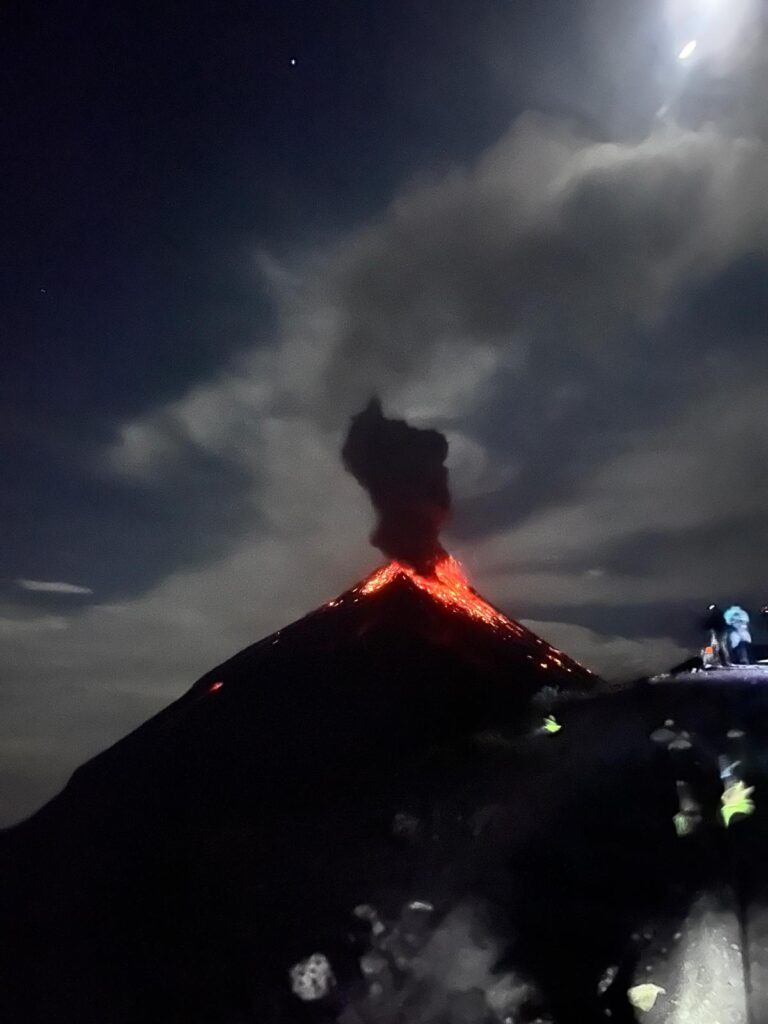
Viewing point for Fuego Volcano.
After 2 hours of a steep hike, you are at one of the most magnificent viewing points in the world! The eruption sound is overwhelming and watching red lava exploding hundreds of meters from the crater at nighttime is just mindblowing!
I suggest wearing gloves, a hat and warm clothes, it gets really cold, especially in windy conditions.

We spent an hour at the viewing point watching this incredible natural phenomenon. Fuego Volcano lava eruptions are visible while hiking back toward the base camp.

What to know about Fuego Volcano.
Fuego Volcano is one of Central America’s most active volcanoes. It stands at about 3,763 meters (12,346 feet) above sea level and is known for its frequent eruptions, which often include explosive activity and ash emissions.
The volcano is categorized as Strombolian eruptions. These eruptions can produce spectacular lava fountaining and ash plumes that rise several kilometers into the atmosphere.
The smoke consists of volcanic gases, which can impact air quality and local weather. However, it is not disruptive during the Fuego hike. Viewing points are established at a safe distance where visitors can witness eruptions and the smoking crater.
The activity of Fuego can influence local communities, prompting evacuations during periods of heightened activity. The fertile volcanic soil also supports rich agricultural activities in the region.
The volcano is monitored by various scientific organizations, which track its activity using seismic networks, satellite imagery, and ground surveys to provide early warnings of possible eruptions.

What to pack for hiking Acatenango?
Packing for Acatenango Volcano hike is very important, as the weather conditions differ depending on the altitude.
- Water (4.5-5liters) – hydration is essential.
- High-energy snacks (chocolate, energy bars, nuts, dried fruits) are lightweight and provide necessary energy during the trek.
- Warm clothing – if you are staying overnight in a base camp it gets really cold! Layering is key. Bring base layers, an insulating mid-layer, and an outer jacket to combat the cold at higher elevations. Sleeping bags are provided by the tour operator.
- First aid kit including antiseptic wipes, and altitude sickness medication (if recommended by your doctor).
- A headlamp or flashlight are a MUST.
- Hiking poles,
- Toileters, tissues
- Change for tipping the guide and porters.

How long does it take to hike the Acatenango volcano?
The Acatenango volcano hike is typically a two-day tour with 1570 meters ascent in total. At the end of the first day you reach Base Camp, from where you can optionally hike toward Fuego Volcano (an extra hours both ways) – but this is a strenuous hike.
The next day is an early call at 3.45 am to hike to the summit of Acatenango for a sunrise, which takes around 1.5 hours.
The Volcano Acatenango hike is 16 kilometers in total.
Read also:
Acatenago hike packing list:
You’ll carry everything yourself unless you hire a porter, so pack light but warm. A 40-litre backpack is the right size; 30 litres is a squeeze once you add food and water.
Clothing (layer up)
- Hiking boots with ankle support, worn in
- Quick-dry T-shirt for the climb
- Thermal base layer, top and leggings, for camp and sleeping
- Fleece
- Down or synthetic puffer jacket
- Windproof and waterproof shell
- Warm hat, gloves and a buff for the wind and volcanic dust
- Two pairs of warm wool socks, one kept dry for the night
Gear
- At least 3–4 litres of water; there is none on the trail
- Head torch with spare batteries
- Trekking poles, or a rented stick at the trailhead
- Power bank kept in your sleeping bag, because cold kills batteries
- Snacks: nuts, chocolate, bananas
- Sunscreen and sunglasses; the sun at altitude is fierce
- Toilet paper and a small rubbish bag
- Cash in quetzales for the entrance fee, porter and tips
Most operators lend jackets, hats, gloves and poles free or for a few dollars.
Freestyle tips you won't find in other guides.
These are the small things that make the difference between surviving Acatenango and loving it.
- Acclimatise with a warm-up volcano. Hike Pacaya (2,552 m) or Cerro de la Cruz a day or two before. Your lungs will thank you at 3,500 m.
- Use the “rest step”. On steep sections, lock your back knee for a split second on every step. It rests your muscles without stopping, and you’ll keep a steady rhythm while others stop and start.
- Breathe through the dust. Wear your buff over your nose on the final scree slope and on the descent. Fine volcanic dust gets everywhere.
- Sleep in tomorrow’s clothes. Put your summit layers inside your sleeping bag overnight so they’re warm at 4:00.
- Fill a water bottle with hot water at dinner and take it into your sleeping bag as a hot-water bottle. It’s the best free heater on the mountain. I CANNOT survive any mountain without this!
- Photograph the eruptions on a tripod or a rock. Use night mode or a 2–4 second exposure, and keep shooting: you’ll know the next eruption is coming when the glow at the crater brightens.
- Don’t film everything. Put the phone down for at least one eruption. The sound and the shockwave are what you’ll remember.
- Hire a porter on the way up, not down. The climb is the hard part. A porter for your bag uphill costs about the price of a meal in Antigua and supports local families.
- Bring something salty. After hours of sweating, crisps or salted nuts taste better than any chocolate bar and help with cramps.
- Book the night after in Antigua, not a bus. You’ll be back by early afternoon, covered in dust, with jelly legs. Plan a hot shower, a massage and a slow dinner, not a 4-hour shuttle to Lake Atitlán.
Is the Acatenango hike safe?
With a registered guide and the right gear, Acatenango is safe for most healthy hikers.
Fuego, though, is a genuinely dangerous volcano, and it deserves respect.
In June 2018 a major eruption killed hundreds of people in villages below the volcano. In August 2026 Fuego entered another strong eruptive phase. The authorities briefly restricted all hikes on Fuego and Acatenango, and the phase was declared over on 5 August. Overnight hikes to Acatenango have since resumed, but access can close again at short notice. Before you book, check the latest status with your operator and Guatemala’s volcano agency.
Travel insurance. Make sure your policy covers hiking up to 4,000 m.
Note: This post may contain affiliate links, which are at absolutely no cost to you – I can earn a small commission on sales generated through this website and thanks to that I can share travel guides and inspirations that may help you reach your dream destinations and discover our unique world. I only recommend sites I actually use and have traveled to. Thank you for your support!